
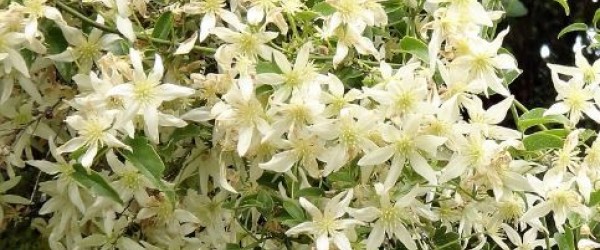

FAMILY: Ranunculaceae Buttercup family
BOTANICAL NAME: Clematis forsteri
PREVIOUS NAMES: Clematis hexasepala; Clematis colensoi; Clematis australis
MĀORI NAME: PŌĀNANGA, puawānanga, pikiarero, pōtaetae (names in PlantsDetails.Williams 1971); pōhue, pōhuehue, pōpōhue (names given to several climbing or trailing plants); puatanatana (PlantsDetailsThomson 1855 -almost certainly a misspelling); puataua, puatautaua (Taylor 1855), puatataua.
COMMON NAME: small white clematis; the smaller clematis
MEDICINAL: A decoction of the bark and stems of the pikiarero and the root of the tātarahake (Coprosma acerosa) taken, `slightly alterative' (Colenso 1869a). Leaves used by the Māori as a blister or counter-irritant (PlantsDetails.Thomson 1855, Fulton 1922). Leaves used, like horopito, to wean a child from the breast. Leaves crushed and rubbed on breasts (Best 1908). Sap blown onto styes, used for horses chafed fetlocks (MacDonald 1973). Related pharmacology in Brooker, Cambie and Cooper 1987.
DOMESTIC: Used for female head-dresses (various Clematis spp.) (Colenso 1869a, 1869b)
CONSTRUCTION: Some pā ramparts (Tapatahi pā at Waipiro, and the Orongo-iri pā) said to have ramparts composed of stones with clay worked in between them. Pieces of aka pōānanga (Clematis vine) were mixed with the clay to bind the fabric. Such a wall was called koperu or parihi (Best 1927)