
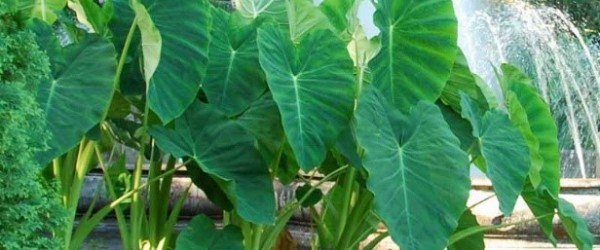
FAMILY: Araceae
BOTANICAL NAME: Colocasia esculenta
MĀORI NAME: taro
DESCRIPTION: Several distinct cultivars. Listed in PlantsColenso 1881 (and in this database under cultivar name). Plants Hammond 1894 mentions that he once saw a flowering variety of the taro at Taumata Wī, the home of J. Webster, Hokianga.
MEDICINAL: Corms contain anthocyanins, with antioxidant and anti-inflammatory properties.
See Riley 1994 for information on medicinal uses of related plants elsewhere in the world.
FOOD: Important food crop. Many references in database. Ate root, thick stems and leaves. (Colenso 1869a, 1869b). Details on cultivation, harvesting, ceremonial uses in Colenso 1881. This plant was introduced by the natives when they first came; it is cultivated as an article of food. (Taylor 1855). Neat plantations described in Nicholas 1817 (p.351). Unlike kūmara, the taro wasn't dug up till it was ready for cooking. Scraped, cooked in hangi. 'Very good to eat, being floury and mealy (mangaro)' (Makereti 1938) The Polynesian taro was grown in South Westland. Small areas of bush close to settlements were cut and burnt to provide ideal growing conditions for kūmara, taro and potatoes. Growing at Makawhio as late as 1900 (Madgwick 1992). Whawha taro. The sheathing petiole or leafstalks of the taro. Eaten (Best 1922).
TRADITIONS: Ceremonial uses described. (Colenso 1881) Brought to New Zealand by Turi in canoe Aotea (West Coast Māori) (Colenso 1882a). Taken to Chatham Islands by Kahu - did not grow (Te Rangi Hiroa 1949). Roau brought seeds or plants on Nukutere canoe, which landed at Waiaua, near Opotiki (PlantsDetails.Best 1903). Mentioned in tradition of Horouta canoe and introduction of kūmara to New Zealand (Turei 1912) Taro played an important part in many ceremonial observations (Makereti 1938)
PROVERBS: He puia taro nui, he ngata taniwha rau, ekore e ngaro. A cluster of flourishing Taro plants ... a hundred devouring slugs, or leeches, cannot be extirpated = It is difficult to destroy them all. So, with a large tribe. (Colenso 1880: 140)
