
HINAU
Elaeocarpus dentatus
Olive fruit
 Large Hinau tree in Rotorua
This forest tree is found in lower forests from the North Cape to the Dunedin region. It grows to sixty feet, with a trunk three feet in diameter, covered with a grey bark.
 much smaller tree just getting established
The leaves are two to four inches in length, oblong and broader towards the tip. They have furled edges, so that sometimes it is not obvious that the leaves have serrated margins. They have a covering of soft white hairs on the under side, and come alternatively up the stem, with a cluster of leaves at the top.

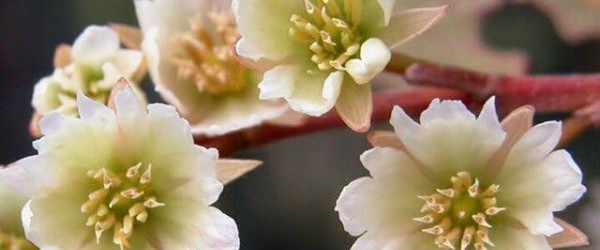
In October and November they bear abundant white flowers, the petals notched into three lobes at the tip. There are five to twelve flowers on each stern, which hangs drooping from among the leaves.
 Hinau flowers hanging down amongst the leaves
 leaves have a covering of soft white hairs on the under side
The fruits, rather like a damson plum, are purple and about half an inch in length, and have a fleshy pulp enclosing a hard kernel. They fall on to the ground in heaps, and rats and pigs eat them greedily, but they are not attractive or palatable to humans when eaten raw.
 Olive fruit
Hinau berries were an important food to the Maori people in ancient times, though they went through an elaborate process before they were eaten.
One method was to collect the berries in bark baskets (papa totara); then turn them into finely plaited containers made from split supplejack vines, and pounded to separate the flesh from the kernels. These pounders were made from pieces of wood, rounded at one end and called tuki. They threw away the kernels and formed the mealy portion into large cakes and cooked them in a hangi, or earth oven (umu).

These cakes hardened as they cooled so it was quite an art to cook them for the correct time, as they were too hard to eat if over-cooked. Some of the older Maori women who could judge the timing were given the honour of watching the ovens. When cold the cakes were packed into creels lined with leaves, covered with bracken fern, and sunk into pools. Preserved in this manner, they would keep for more than a year.
Another method was to soak the berries in water for a month or so, usually in the hull of a canoe; then lift them out and dry them on flax mats in the sun. They then rubbed them between their hands to separate the floury part from the skin and kernels before baking them into cakes. “
“The medical value of this tree was as a bath - a hot decoction of the bark in which patients soaked, is said to cure the severest skin diseases.” (O’Carroll.)