
KARAKA
Corynocarpus laevigatus

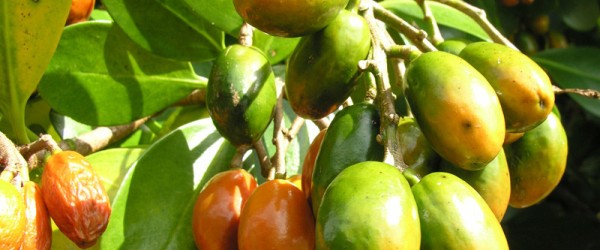
A coastal tree of the North Island, but found as far south as 'Westport and Banks Peninsula. It is an evergreen, thirty to fifty feet in height, with wide spreading branches. The leaves are thick and smooth, dark glossy green in colour, oval and three to seven inches long. The trunk is grey, smooth, and usually two feet in diameter. Karaka is often found in groves, where the Maoris planted it for their berries and leaves. It is a beautiful sight in January and February when the berries ripen, and they hang in clusters from under the leaves. Each berry is the size of a small plum, shaped like an egg, and turns from green to a bright orange. To the Maoris, especially the children, the flesh of the berries was a great treat.

The most important thing for us to remember about this tree is that the kernel in the berry (when fresh or raw) contains a virulent alkaloid poison, which brings on convulsions of the limbs which, if the patient does recover, are usually permanently distorted.

The kernels were a staple food of the Maori people. They preferred them to the mealy portion but, before being eaten, they were treated as follows. The berries were placed in a basket of split supplejack; then pounded in a trough to separate the flesh from the kernels. The basket was then soaked in water for a long period (usually tied to a stake in a running stream).
The kernels were then steamed for several hours. If not eaten at once, they were spread on a mat to dry in the sun; then stored in baskets for future use.
The leaves placed over wounds are healing, but care must be taken to put the green upper surface to the wound. The under surface “draws” and was used on boils.
 The Maori people wore chaplets of karaka leaves on their
heads when visiting the graves of their dead.
The Maori people wore chaplets of karaka leaves on their
heads when visiting the graves of their dead.