
KOHEKOHE
Dysoxylum spectabile
 Though often called ”The New Zealand Cedar”, this handsome
forest tree belongs to the true mahogany family. It is endemic
to this country and is common in the coastal and lowland areas
of the North Island and in the Marlborough Sounds.
Though often called ”The New Zealand Cedar”, this handsome
forest tree belongs to the true mahogany family. It is endemic
to this country and is common in the coastal and lowland areas
of the North Island and in the Marlborough Sounds.

 The leaves are most unusual in so large a tree. They are
as much as eighteen inches in length, being made up of large,
glossy leaflets with deeply cut veins. These hang from a central
stem in three to five pairs, with a single end leaf.
The leaves are most unusual in so large a tree. They are
as much as eighteen inches in length, being made up of large,
glossy leaflets with deeply cut veins. These hang from a central
stem in three to five pairs, with a single end leaf.
 The flowers,
too, are unusual. They are white and hang singly, in chains,
from a drooping stem.
The flowers,
too, are unusual. They are white and hang singly, in chains,
from a drooping stem.
 The flower centre is like the trumpet of
a small daflodil. They are produced low on the branches and
even come from the trunk itself.
The flower centre is like the trumpet of
a small daflodil. They are produced low on the branches and
even come from the trunk itself.
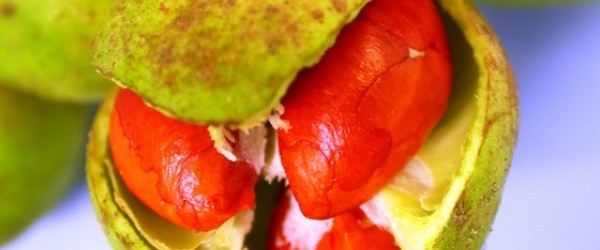
 The seeds are contained in a
capsule which splits open to show an orange-reddish flesh
round the seeds.
The seeds are contained in a
capsule which splits open to show an orange-reddish flesh
round the seeds.
 The wood is dark red and can be highly polished. It is light
but strong, and is a favourite wood with cabinet makers.
The wood is dark red and can be highly polished. It is light
but strong, and is a favourite wood with cabinet makers.
The medicinal uses of the bark and leaves are well known and were widely used. “The young bark is said to contain a bitter principle having tonic qualities similar to quinine” (Goldie). The bark and heart wood have been investigated and much tannin has been found.
A decoction of the leaves and bark was drunk as a bitter tonic to allay a cough. An infusion of the leaves in boiling water was made, and the vapour inhaled. This was excellent for a cold in the head or for feverishness. The liquid was drunk for a lung haemorrhage (Adams). The astringent pulp of the inner bark was taken for the same sickness, and also used as a wash for boils and as a gargle for sore throats. A decoction of the bark and leaves stopped the flow of milk when applied to the breasts. The boiled leaves, while still hot, were applied as poultices. A weak solution of the leaves was taken as a tonic by invalids. For all these remedies the leaves must be picked from the side of the tree facing the sun. For skin eruptions, kidney disorders, bleeding piles, female haemorrhage, and other blood disorders a decoction of the following was taken three times a day before meals: kohekohe bark, manuka bark, korari stalk (a flax), puawanganga vine and kanuka leaves.
Pickmere has written that this plant was used in some way to cure convulsions caused by eating raw karaka kernels, or at least to straighten the limbs before death.