KOWHAI
Sophora tetraptera, Sophora microphylla
New Zealand laburnum

S. tetraptera is the large-leaved variety, found only on the east coast of New Zealand. S. microphylla has smaller and less numerous leaves and flowers, and is more widely distributed. In one form or another these trees are found throughout New Zealand as single trees, or in groups at the edges of forests, or out on the plains. They begin life as a small evergreen shrub, with twisted branches and slender narrow leaflets on black stems, 35 to 81 on the smaller varieties, and 25 to 60 on S. tetraptera. As they grow, the straight trunk begins to form and the leaves become larger.
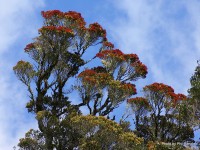
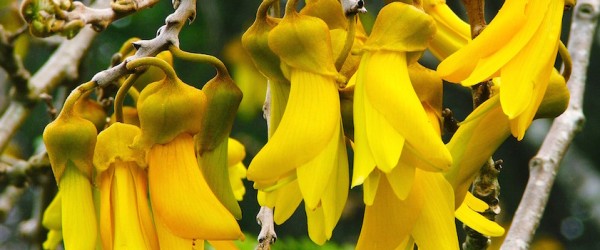
It does not bloom as a shrub, but after several years (I noted in my garden that one took five years), the leaves fall in July for the first time. Later in the same month,or early in August, it comes into bloom. The flowers are a bright yellow, with a soft green and yellow basal cup. They hang in clusters from a short black stem, strongly resembling the laburnum flower. (Both belong to the pea family.) These lovely flowers cover the whole top of the tree and upper branches so that, from a distance, it appears as a golden yellow ball.

The seeds are contained in grey-brown hard pods and vary in number from four to seven in each. The pod is pinched between each seed and, as it does not open when ripe, or soften in water, the seed coat has to be nicked in four places before planting. They germinate well. The new leaflets formjust after flowering. They are a pale gold and green and unfurl as a fern frond does. The taller kowhai can grow to forty feet. The wood is tough and very durable, and was used for fence posts and tool handles by early settlers. The heart of the wood has a reddish grain and has been used for cabinet work.
The medicinal uses are the same for both varieties. The bark was used for many cures and was obtained in the following way. A tree growing on the side of a hill was chosen. Then a root growing down the slope on the sunny side was selected. The outer skin was scraped away; also the next skin, leaving the central core. The juice was extracted from this, and a small spoonful was taken three times daily. Dr. Bell states that this cured gonorrhea in a few days.
An infusion of bark was mixed with wood ashes and allowed to dry. The Maoris then rubbed it over their bodies for various skin rashes. For “itch” they used an infusion of the inner bark. The bark was crushed and steeped in boiling water for some hours. Severe bruises and newly set fractures were bathed with the liquid. The fractures set better and more quickly with this treatment, and it is recorded by many authorities as a reliable remedy.
The leaves were boiled and the liquid used to bathe a wound before covering it with the bruised leaves as a bandage.
The Maoris rubbed the ashes over their heads for ringworm. For colds and sore throats they steeped kowhai leaves in boiling water and drank the liquid. This did not keep and had to be made fresh each day.
The bark of both kowhai and manuka was boiled together and the liquid was rubbed over patients with back aches. This mixture was also drunk for internal pains. Bark was taken only from the sunny side of this tree, so that the tree itself did not die, as it was the Maori way of life to conserve all their food and medicine sources — not waste them.

Native birds, especially tuis, love the abundant nectar in kowhai flowers. The smaller kowhai is often planted in gardens as an ornamental tree and, if we have one, we should hang in the branches during winter some coconut husks filled with sugar and water to encourage native birds, and , who knows? 7 they may decide to stay in the garden for the nectar in the spring. The flowers were used for dyes, and these range from gold, fawn, brown, tan to khaki.
Whatever its practical uses, the kowhai in bloom is one of the most beautiful trees in a land of lovely trees. George Nepia, the Maori All Black, relates how he was “cured by kowhai”:

In came the doctor. He examined the leg very carefully. “I will have to operate,” he said. “The blood has congealed. If it is not taken away you could get blood—poisoning.” “No knife for me,” I said flatly. “I’m off.” I had already been told by Lui Paewai’s mother that she would treat me, Kowhai, she said. The bark of the kowhai. That is what you need. She met me at the train at Dannevirke and we drove to the farm at Tahoraiti, a few miles out. There, in a stand of bush there were hundreds of kowhai trees. Mrs Paewai told me what I must do. Only the bark facing the rays of the sun was to be taken from the trees. Then we started. Not until we had filled two big sacks with bark did we stop. Later, I was told to cut the strips into short lengths of about a foot and to hammer each length until it was bruised. Next the strips were put into a copper full of water and for two or three hours I kept the water at the boil until it had turned to a dark tan in colour. This was ladled into a bath and as soon as the temperature was right I stripped off and lay full length. A full hour I stayed there before Mrs Paewai returned to inspect the leg. By now, it was discoloured in many places. When she went out of the room, I heard a bottle break. When she came back, she made me hold my leg out of the water. In two of her fingers, she held a smallish piece of glass and with this she started to dab my thigh, cutting little nicks all around the leg from the knee up.
More of the hot bark water was added. I must remain in the bath, Mrs Paewai said, for another hour.
I slept. When I woke, the water had turned a deep dark shade of brown. The colour seemed to be coming to the surface from my leg. I called out to Mrs Paewai. As she came in, I lifted my leg. From out of all the little nicks there was oozing dark blood. She was jubilant. She cried out in Maori, again and again, “Kua pai tou waewae” (your leg is better). You will have no more worry, she said. In a week’s time, you will be playing. There will be no more trouble. What a contrast, I thought. A Pakeha doctor had told me I would not play again during the season. The injury is too serious, he said. A Maori woman, using Maori treatment, had cured me. Play soon, she said.
Back in Napier, I showed the leg to Mr McKenzie and to Hildebrandt. Only here and there could you find trace of the nicks. The majority were healed. Mr McKenzie was pleased. Hildebrandt was ecstatic. “It is a miracle, he said. “I did not tell you, but I knew your leg was in a bad way. A very bad way. I doubt that an operation would have helped. I was almost certain your playing career was finished.”* Fourteen days later he played again.