TITOKI - New Zealand ash
Alectryon excelsus

A handsome tree which grows all over the North Island and in the northern parts of the South Island. It grows best on lower forest slopes, river flats, and in stream valleys. It reaches a height of thirty to forty feet, and the trunk of a large tree can be three feet in diameter. The leaves are compound, with seven to thirteen leaflets, which are narrow, often toothed, and two to four inches long. Leaves, twigs and flowering branchlets are covered with rusty hairs.

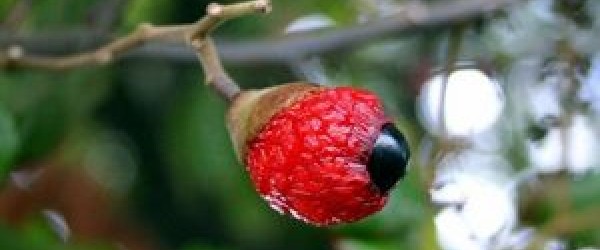
The most conspicuous feature of this tree, and the one by which it is most easily recognised, is the fruit, which is carried on brown, four-inch woody stems. It is contained in a brown capsule, which splits open to reveal a single shiny black seed surrounded by bright scarlet pulp. The titoki blooms in October and November, and as the seed takes a year to ripen, you can often see flowers and seeds at the same time.
 The fruit is poisonous and should not be eaten.The old—time
Maori extracted an oil from the seed, which was used to anoint
the body. The green oil was applied externally to sores, wounds,
bruises and rheumatic joints, and to sore eyes and ears. Women
rubbed it over sore breasts. For babies it was rubbed on the skin
where chafed and, soaked in a cloth, was bandaged over the navel
of a new—born baby, if the skin required softening.
The fruit is poisonous and should not be eaten.The old—time
Maori extracted an oil from the seed, which was used to anoint
the body. The green oil was applied externally to sores, wounds,
bruises and rheumatic joints, and to sore eyes and ears. Women
rubbed it over sore breasts. For babies it was rubbed on the skin
where chafed and, soaked in a cloth, was bandaged over the navel
of a new—born baby, if the skin required softening.
 The leaves are a very good insecticide. They are bruised and
boiled, and the liquid rubbed on the skin. This keeps sand flies
at a distance. If you are stung at any time, bruise a leaf and rub
the juice on the bites. This will ease the pain and take away
swelling.
The leaves are a very good insecticide. They are bruised and
boiled, and the liquid rubbed on the skin. This keeps sand flies
at a distance. If you are stung at any time, bruise a leaf and rub
the juice on the bites. This will ease the pain and take away
swelling.