
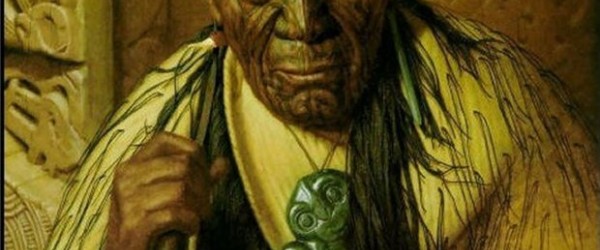

The tohunga (above) taught in the wharewananga, (below) the “house for instruction in occult lore”

(Williams’ Dictionary of the [Maori Language), that “water was one of the chief necessities of life, others being the sun, the moon and the stars. Lacking moisture, all things would fail on the earth. Clouds were mist—like emanations originating in the warmth of Mother Earth.” Her promise to her children was “when death comes to them they shall return to me, and I will shelter them. They will re-enter me and find rest.”
It was the tohunga, the priestly scholar, who carried in his head, and passed on to his pupils, the lineage of the chief, and tribal history. He could repeat these back through hundreds of years, and if one doubts the ability to pass on verbal history to this extent, we should remember that the Iliad was handed down for generations before being written by the Greeks. It is reliance on the written language which impairs the memory. The tohunga held the power of tapu over the tribe. The definition of this term is given in Williams’ Dictionary as ”under religious or superstitious restriction; a condition affecting persons, places, and things, and arising from innumerable causes.” (The modern definition is “sacred”.) “Anyone violating tapu contracted a hara,” which is defined as to “violate tapu, intentionally or otherwise” A a sin or offence. As a rule, elaborate ceremonies were necessary to remove tapu and make anything noa, that is, “free from tapu or any other restrictions.”
Apart from its ancient superstitious rites, tapu was not just a rule of fear over the people. Many of the edicts were imposed for reasons of health, safety, and the protection of the family and tribe, and to conserve the forms of nature around them.

For instance, it was tapu to snare a pigeon which was nesting or feeding her young. It was tapu to cut down a tree unless it was needed for shelter, for canoes, or for fire-making. It was tapu to dig up the kumara beds before the tohunga said that the tubers were ready. The law of tapu said that the first fish of the catch must be returned to the sea live, as an offering to the sea god. It was tapu to disturb a grave. (This displeased the earth mother.) A house was tapu after a death had taken place in it, and this was not lifted for several days (probably a form of disinfection). To make a sick body clean, the tohunga was very ready to put a patient in running water, which was not such a good idea if he had a fever!
Tapu was rigidly adhered to, and believed in by the people, who deeply respected it, and feared the consequences of disobedience to its laws.
The tohunga knew the herbal uses of plants and ordered them to be used in conjunction with an intoned karakia, defined as a “charm, spell, incantation; particularly the ancient rites proper to every important matter in the life of the Maori.” Some of the tohungas kept their knowledge of herbal plants secret to increase their prestige with the common people, but the Maoris would soon realise, by the plants he ordered them to use, the special value of a plant for a certain disease; and when the power of the tohunga waned, this knowledge was kept alive, and passed down by the older women of the tribes, who continued to use their old remedies, and still do to the present day.
day. This is a karakia intoned by the tohunga while the women applied a herbal bandage to a burn :-
