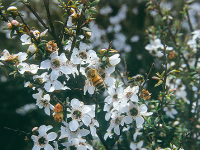
MAKOMAKO
Aristotelia serrata
Wineberry

This is a small tree from twelve to thirty feet in height, abundant throughout New Zealand. It is always the first tree to grow in bush clearings after tree felling or burning has disturbed an area. The seed remains dormant for a long time, as it could not be planted, or the seed blown to fall in patches. The bark is reddish when young, but turns dark grey as the tree matures. In the days of the early settlers they burned this wood in great quantities to get charcoal for the making of gunpowder.
 Makomako has pale green, broad, acute—pointed leaves with
serrated edges. They come in opposite pairs from the branchlets
and when young are tinted purple on the under surface.
Makomako has pale green, broad, acute—pointed leaves with
serrated edges. They come in opposite pairs from the branchlets
and when young are tinted purple on the under surface.
 The
flowers, which are numerous, are produced in clusters from
below the leaves in October and November. In the same
cluster the flowers vary in tone from pale pink to deep red.
The
flowers, which are numerous, are produced in clusters from
below the leaves in October and November. In the same
cluster the flowers vary in tone from pale pink to deep red.
 The
fruit, when it ripens — from November to February**,**is in the
form of berries about a quarter of an inch long. They hang in
bunches like small grapes and are red to black in colour. They
are safe to eat raw and are quite edible. This is an ornamental
tree of great beauty in the summer months and is often planted
in large gardens. Early settlers made jelly of the berries.
The
fruit, when it ripens — from November to February**,**is in the
form of berries about a quarter of an inch long. They hang in
bunches like small grapes and are red to black in colour. They
are safe to eat raw and are quite edible. This is an ornamental
tree of great beauty in the summer months and is often planted
in large gardens. Early settlers made jelly of the berries.
The leaves and bark had medicinal value for the Maori
people.
 They boiled the leaves in a little water and used the liquid to bathe rheumatic joints, and to soothe burns. This was
helpful for boils and sore eyes (K. Kahiki). They also soaked the
bark in cold water for eye troubles.
They boiled the leaves in a little water and used the liquid to bathe rheumatic joints, and to soothe burns. This was
helpful for boils and sore eyes (K. Kahiki). They also soaked the
bark in cold water for eye troubles.
The bark was boiled in a large amount of water, and people with rheumatic joints soaked in this while still hot. It was soothing and healing (Poverty Bay Cookery Calendar).