MANUKA, KAHIKATOA - Tea tree, red manuka Leptospermum scoparium
MANUKA, KANUKA - Tree manuka, white manuka Leptospermum ericoide;
 L. scoparium is a shrub or small tree found in most areas of the
North and South Islands in groups on hill sides, in coastal
areas, and at the edges of forests. Both varieties grow in the high
country as well. The wood is red. The leaves are small and sharp
pointed, and the flowers are borne at the tips of short stems and
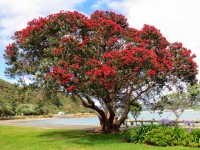
grow singly. There is a profusion of bloom in spring and early summer, sometimes covering the whole shrub in a white
L. scoparium is a shrub or small tree found in most areas of the
North and South Islands in groups on hill sides, in coastal
areas, and at the edges of forests. Both varieties grow in the high
country as well. The wood is red. The leaves are small and sharp
pointed, and the flowers are borne at the tips of short stems and
grow singly. There is a profusion of bloom in spring and early summer, sometimes covering the whole shrub in a white
 cloud. Even a tiny seedling, a few inches high, will have a single flower.
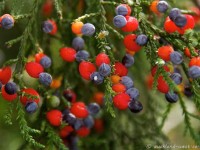
 The brown woody capsules project from the cup and are notched
in five equal parts at the top.
The brown woody capsules project from the cup and are notched
in five equal parts at the top.

Captain Cook gave it the name of “tea plant”, and wrote of it: “The leaves were used by many of us as tea, which has a very agreeable bitter taste and flavour when they are recent but loses some of both when they are dried. When the infusion was made strong, it proved emetic to some in the same manner as ‘green tea’.” When Captain Bligh of the Bounty went ashore in Tasmania, he found it there, and wrote: “What is called the New Zealand tea plant grows here in abundance, so that we not only gathered and dried it for use as tea, but found it made excellent brooms.”
 Early settlers gave it the name “tea tree” as they, too,
made a drink of it. In this, and many other instances, they
resorted to native plants when ships were late and supplies
ran out.
L. ericoides, kanuka, the white manuka, so called because
the wood is white, is another species which grows into a tree
sometimes fifty feet in height. This has smaller, blunt—ended,
scented leaves and flowers which grow in clusters. The capsule
is smaller and is sunk in the cup. The seeds may remain on the
tree for years. This manuka is found everywhere, but also in
forests where the smaller L. scoparium would smother.
Early settlers gave it the name “tea tree” as they, too,
made a drink of it. In this, and many other instances, they
resorted to native plants when ships were late and supplies
ran out.
L. ericoides, kanuka, the white manuka, so called because
the wood is white, is another species which grows into a tree
sometimes fifty feet in height. This has smaller, blunt—ended,
scented leaves and flowers which grow in clusters. The capsule
is smaller and is sunk in the cup. The seeds may remain on the
tree for years. This manuka is found everywhere, but also in
forests where the smaller L. scoparium would smother.
Both plants have the same virtues, but the Maori people preferred this variety, using the leaves and bark in a variety of ways to cure their common ailments.

They gathered the leaves as remedies for the following ills. A decoction of them was drunk for urinary complaints and as a febrifuge. The leaves were boiled in water and, while hot, inhaled for colds in the head. Leaves and bark were boiled together, and the warm liquid was rubbed on stiff backs and rheumatic joints. The leaves and young branches were put into many vapour baths. Polack wrote tactfully that “an infusion of the leaves of this herb is regarded as peculiarly serviceable to persons. in a reduced state, whose previous moralities will not admit of the strictest investigation. It is very astringent.” And this from James Neill: ”It is a well known diuretic when drunk in quantity; and I remember hearing of a doctor in Dunedin in the early days, who told a patient who had dropsy, to go into the bush, gather a handful of manuka leaves, put them in a quart jug and fill it up with boiling water, and drink it often. She did this and was cured.”
Young shoots were chewed and swallowed for dysentery.
The bark, too, was very valuable to the Maori. An infusion of the inner bark was taken internally as a sedative and promoted sleep easily and safely, and was also given as a sedative to an excited person or one in pain. Externally this was rubbed on the skin to ease pain, and was said to help in healing fractures. The crushed bark was steeped in boiling water and the water used for inflammations, especially for women with congestion of the breasts.
For constipation pieces of bark were boiled until the water darkened in colour, and the liquid drunk.
The inner bark was boiled and the water was used as a gargle, mouth wash and for bathing sore eyes. During the winter eyes became inflamed from the smoke of the fires in their whares. The emollient white gum, a sugary exudation called pia manuka, was given to suckling babies, and was applied to scalds and burns. It was chewed by people to ease a bad cough, and bv children to relieve constipation.
Fresh sap drawn from a short length of the trunk suspended from a tree was taken as a blood purifier (Adams).
The seed capsules were boiled and the fluid used externally to bathe bruises and inflammation. It was taken internally for diarrhoea and dysentery. In some cases the Maori people chewed the capsules for the same complaints.
For colic six or eight capsules were chewed every ten minutes until the pain subsided (Poverty Bay Cookery Calendar). A poultice of the powdered capsules were used to dry up an open wound or a running sore.
An old belief was that this scented manuka was the toa, or male tree, and therefore stronger, and that the bark should be taken when the leaves were drooping and fragrant. Apiarists say that manuka honey is second only to the famous heather honey of Scotland. The manuka has often been called a herb. (See lane/mi and [01am for further uses Of the bark of In anuka.)