POHUTUKAWA
Mtrosideros excelsa
Christmas tree
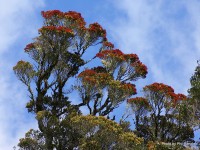
 This tree was called the Christmas tree by the early settlers
because its scarlet blossoms appeared at that time of the year
and they used them to decorate their homes instead of English
holly.
This tree was called the Christmas tree by the early settlers
because its scarlet blossoms appeared at that time of the year
and they used them to decorate their homes instead of English
holly.
The natural habitat of this picturesque native tree is on the sea coast of the Auckland Province,
 where it literally hangs over
the cliff edges, firmly anchored by its fibrous roots.
where it literally hangs over
the cliff edges, firmly anchored by its fibrous roots.
It grows to about seventy feet, branching from near the base, but the spread of these branches can be so wide that the true height of the tree is dwarfed. The Maoris took it to Rotorua and Taupo, but it is a northern coastal tree and grows nowhere else so well.
 The leaves are one to four inches long, growing opposite each
other on the stem, a dark glossy green above, the underside
and stems a pale green, covered with short, white, woolly
hairs. The clusters of buds at the top of the leaf stems are also
covered in this way. The round, flat flowers are a mass of
stamens, and so profuse is the bloom that the tree is literally a
mass of brilliant scarlet colour.
The leaves are one to four inches long, growing opposite each
other on the stem, a dark glossy green above, the underside
and stems a pale green, covered with short, white, woolly
hairs. The clusters of buds at the top of the leaf stems are also
covered in this way. The round, flat flowers are a mass of
stamens, and so profuse is the bloom that the tree is literally a
mass of brilliant scarlet colour.
The wood is deep red in colour, durable and of great strength. In the early days of the colony ships came to New Zealand specially for the wood, as it was ideal for boat building. . The inner bark contains tannin and the Maoris used 1t to stop bleeding. They bound it against the wound or made 'a poultice of the boiled and powdered bark, and bandaged it over a wound.
For toothache a piece of the inner bark was held in the mouth, or they steeped bark in water and used it as a mouthwash and gargle. This liquid, taken internally, was effective for diarrhoea (Goldie).
 The flowers contain much nectar and people with sore throats sucked this honey through a reed.