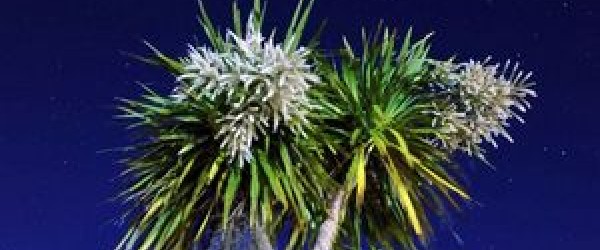
TI KAUKA, WHANAKE - Cabbage tree
Cordyline australis
 This tree is found everywhere in New Zealand except in virgin
forests. It is a unique and easily recognised feature of the
landscape, growing in swamps, edges of forests, in groves on the
plains; even in coastal areas. It is from fifteen to forty feet
in height. The trunk is from two to four feet thick and very
wrinkled and rough. Young trees have a single head, but mature
trees have several short stems which end in a bush of large,
grass—like leaves, the whole making a rounded crown. Though
endemic, this tree is grown overseas. A short length of trunk
is taken, and planted laterally in the ground and shoots grow
from this.
This tree is found everywhere in New Zealand except in virgin
forests. It is a unique and easily recognised feature of the
landscape, growing in swamps, edges of forests, in groves on the
plains; even in coastal areas. It is from fifteen to forty feet
in height. The trunk is from two to four feet thick and very
wrinkled and rough. Young trees have a single head, but mature
trees have several short stems which end in a bush of large,
grass—like leaves, the whole making a rounded crown. Though
endemic, this tree is grown overseas. A short length of trunk
is taken, and planted laterally in the ground and shoots grow
from this.
 It blooms sometimes. The flowers appear in a bunch of
white blossoms among the upper stems. When it does flower
well the Maoris say that it is a sign of a good summer.
It blooms sometimes. The flowers appear in a bunch of
white blossoms among the upper stems. When it does flower
well the Maoris say that it is a sign of a good summer.
The inner blanched leaves and hearts were eaten by Maoris, bushmen and settlers, and Captain Cook had them boiled for his sailors. The bases of the leaves were also eaten raw.
For dysentery and diarrhoea they drank an infusion of the leaves (Goldie).
The leaves were rubbed to soften them; then applied as an ointment to cuts, sores and cracks in the skin. Nursing mothers ate the boiled inner shoot and top of the stem. This mixture was also given to children for colic. Boiling the inner shoot and leaves takes an hour. The plaited leaves were sometimes used for rough shelters.
 This tree was a favourite among us as children for quite
another reason. Half of us sat on the tufted ends of the grassy
branches while the other half held the stems and towed us
downhill, preferably through a grove of pines. There was
nothing else as exhilarating as this speedy, rushing slide
downhill, sitting safely on a fat cushion of leaves.
This tree was a favourite among us as children for quite
another reason. Half of us sat on the tufted ends of the grassy
branches while the other half held the stems and towed us
downhill, preferably through a grove of pines. There was
nothing else as exhilarating as this speedy, rushing slide
downhill, sitting safely on a fat cushion of leaves.