Podocarpus dacrydioides
White pine

Iti te kopara, kai takirikiri ana i runga i te kahikatea. (Although the kopara is a small bird, it prefers to frequent the very top of the kahikatea tree.)
This tree begins as a shrub of quite different appearance from the adult form. It is erect, with both short and long bronze—coloured flat leaves.
 The adult tree is a forest giant usually between eighty and a hundred and twenty feet in height, though much higher specimens have been recorded. The trunk is straight, without
much tapering, with a smooth grey bark. It branches near the
top into a leafy crown, very small for the size of the tree.
The slender, upright branches are covered with tiny green
scale-like leaves, with the fruits at the tips.
The adult tree is a forest giant usually between eighty and a hundred and twenty feet in height, though much higher specimens have been recorded. The trunk is straight, without
much tapering, with a smooth grey bark. It branches near the
top into a leafy crown, very small for the size of the tree.
The slender, upright branches are covered with tiny green
scale-like leaves, with the fruits at the tips.
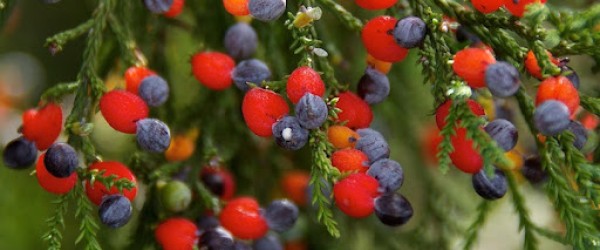
 The shiny black
seeds are carried in a fleshy scarlet cup. When these are in full
colour, the tree is a glorious sight.
The shiny black
seeds are carried in a fleshy scarlet cup. When these are in full
colour, the tree is a glorious sight.
 It grows best in swampy ground and is usually found in
stands with no other species among them. They are to be seen all
over both the North and South Islands, but rarely in Stewart
Island.
It grows best in swampy ground and is usually found in
stands with no other species among them. They are to be seen all
over both the North and South Islands, but rarely in Stewart
Island.
The wood is soft and white, with a clear, even grain and, as it has no turpentine or other odour, was extensively used for butter boxes until the nineteen—thirties. It is a soft wood and not durable enough for house building, though used in cabinet making.
The leaves were used in vapour baths (Goldie), and a decoction of them was drunk for urinary complaints. The bark was used for bruises, the Maoris employing a very elaborate recipe. Chips of the wood were infused in boiling water and drunk as a tonic. This was very effective (O’Carroll). “The bark, if chewed, causes tingling of the lips, followed by slight numbness. It should possess therapeutic properties” (Bell). Hi mokoroa ka hinga te kahikatea. (The small mokoroa grub can destroy the kahikatea tree.)