RIMU - Red pine
Dacrydium cupressinum
 (Largest Rimu tree is in the Marlborough Sounds)
With the exception of the kauri, this is the most useful timber tree in New Zealand. It grows from the semi—tropical forests of the far north to the hill slopes of Stewart Island. It reaches to a height of a hundred feet or more, with a straight, slender trunk up to six feet in diameter, and is covered with a dark brown scaling bark.
Rimu is easily recognised by the unusual appearance of the
foliage, which is carried on slender, drooping branches, each
completely covered with short, stiff, scale—like leaves, pale green
when young and becoming darker as the tree matures. The
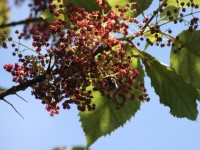
seeds are borne at the branch tips and turn upwards. They look
like shiny blue-black nuts in a scarlet cup.
 The whole appearance of the tree is graceful and elegant.
The rimu produces its leafy, round-headed top when it reaches
high enough to tower above the lower trees in the forest, and
becomes the most conspicuous tree of all.
The whole appearance of the tree is graceful and elegant.
The rimu produces its leafy, round-headed top when it reaches
high enough to tower above the lower trees in the forest, and
becomes the most conspicuous tree of all.
The wood is reddish but dries to a dark brown, streaked with a paler grain running through it and takes a high polish. It was used as a building timber but now, because more rare, it is used for furniture, wall panelling, and other decorative work.
 The Maoris and
early settlers found the bark and leaves of rimu had astringent,
antiseptic and haemostatic qualities. Goldie tells us that the
rimu bark was bruised to a pulp and applied to burns, and that
the very astringent gum obtained by making cuts in the bark
was used to stop the flow of blood from wounds. A lotion for
bathing wounds was made by cutting the bark into pieces with
the scraped bark of tawa, and boiling the whole in water (Best).
An infusion of the bark and leaves was used as a good cure for
running ulcers, and the bruised leaves were bandaged over
sores to good effect. A piece of the red gum about the size of a
walnut was dissolved in hot water and taken internally to stop
bleeding of the lungs and stomach (O’Carroll),
The Maoris and
early settlers found the bark and leaves of rimu had astringent,
antiseptic and haemostatic qualities. Goldie tells us that the
rimu bark was bruised to a pulp and applied to burns, and that
the very astringent gum obtained by making cuts in the bark
was used to stop the flow of blood from wounds. A lotion for
bathing wounds was made by cutting the bark into pieces with
the scraped bark of tawa, and boiling the whole in water (Best).
An infusion of the bark and leaves was used as a good cure for
running ulcers, and the bruised leaves were bandaged over
sores to good effect. A piece of the red gum about the size of a
walnut was dissolved in hot water and taken internally to stop
bleeding of the lungs and stomach (O’Carroll),
Early settlers found a different use altogether. They rubbed the juice from cut stems over bald heads, which smarted at first, but they found it an excellent hair restorer (Bell).

Captain Cook brewed spruce beer from young branches of rimu and this proved to be an effective remedy for scurvy. In Pickersgill Harbour (Dusky Sound), in May 1773, he wrote this in his diary:
Such as were sick and ailing, when we came in, recovered daily, and the whole crew soon became strong and vigorous; which can only be attributed to the healthiness of the place, and the fresh provisions it afforded. The beer certainly contributed not a little. As I have already observed, we at first made it of a decoction of the spruce (rimu) leaves; but finding this alone made the beer too astringent, we afterwards mixed with it an equal quantity of the tea plant (manuka) (a name it obtained in my former voyage from our using it as tea then, as we also did now) which partly destroyed the astringency of the other, and made the beer exceedingly palatable, and esteemed by every one on board.